Etsy shows you what sold. Findig shows you what you actually keep. Here's every number behind that — which fees come out, how your costs are counted, and where nothing is guessed.
 Johannes Tebbert, founder of Findig
·
5 minute read
·
Last reviewed
Johannes Tebbert, founder of Findig
·
5 minute read
·
Last reviewed
Your "revenue" on Etsy is never what lands in your pocket. Between Etsy's fees, postage, and materials, a €29.50 order might really be €18 of profit — and if you don't know which number is which, it's hard to price anything right. Findig does that math for you on every order, using the fees Etsy actually charged rather than a rule of thumb. This page walks through exactly how.
Here's a typical order, from what the buyer paid down to what you actually keep — then the detail on each line:
Example figures. The two Etsy fees at the top aren't percentages Findig guesses — they're read back from Etsy's own fee statement for that order, so whatever Etsy really charged your shop is what comes off. Postage and materials are whatever you actually pay. What's still an estimate →
Findig begins from the order's grand total straight from Etsy — the real amount the buyer was charged, after any coupon or sale.
From that, Findig sets aside the part the buyer paid for postage, so what's left is your true product revenue. Postage is handled separately in step 3, because what a buyer pays for shipping and what it actually costs you to ship are rarely the same number.
Most tools apply a percentage and call it a fee. Findig reads your shop's Etsy payment account statement — the same ledger Etsy bills you from — and takes off the lines Etsy actually charged for that order:
Because the figures come from Etsy's statement, a refunded order reports the fee Etsy actually kept, and a shop in a currency or on terms different from the standard ones is right without anyone hand-maintaining a rate table. What's left is your product revenue after Etsy — before your own costs.
These are the numbers only you know, so Findig uses what you entered when you set up your products:
These are as accurate as the numbers you give Findig — and you can update them anytime, which re-flows through your stats.
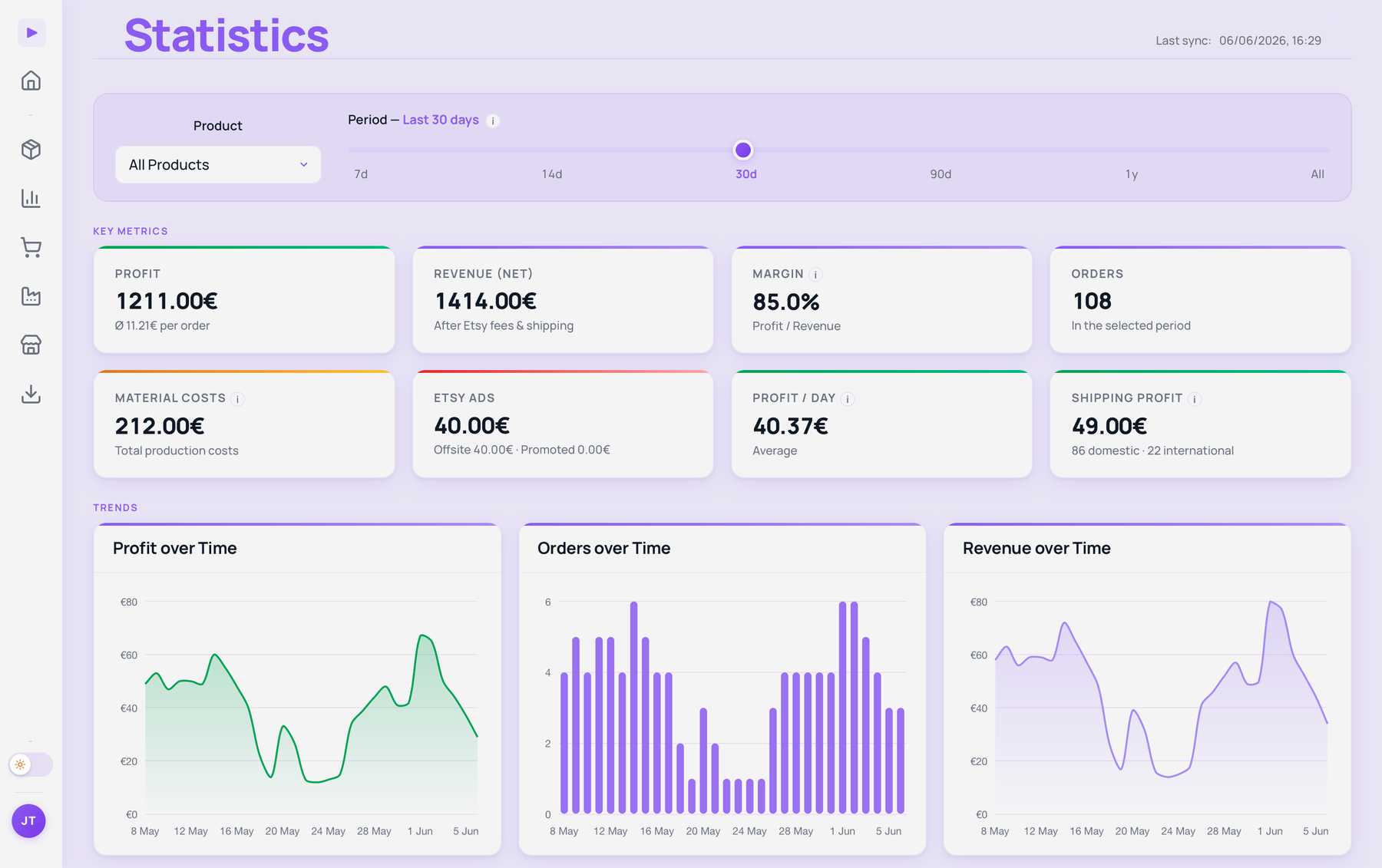
Product revenue, minus Etsy's fees, minus your postage and materials. Findig shows it per product and over time, so you can see which items genuinely earn their keep — not just which ones sell.
Etsy doesn't tell any tool how much income belongs to each item in a multi-item order — it only reports one total for the whole order. So Findig splits that total across the items by each item's share of the price: a €30 item is credited more of the order's profit than a €10 item alongside it. If any line is missing a sale-time price (older orders), Findig falls back to an even split per unit. It's an honest split of a real total — never an invented per-item number.
Most of this is exact: your real order data, and Etsy's real charges. Three things are worth naming out loud:
That fee gap pushes one way: while an order is still on published rates the number Findig shows is higher than your true profit, never lower — and never by much. Etsy Ads and Offsite Ads spend is a separate cost that isn't in this per-order fee line either. Want the fully-loaded figure for a single sale by hand? The fee calculator does it.
Where a number is an estimate, that's by design and said out loud — Findig would rather show you an honest figure with its limits than a precise-looking one that's quietly wrong.
Connect your Etsy shop and Findig works this out on every order automatically — no spreadsheets, no manual fee math. It's free while Findig is in beta — open to any Etsy seller, no invite needed.
Get started free →